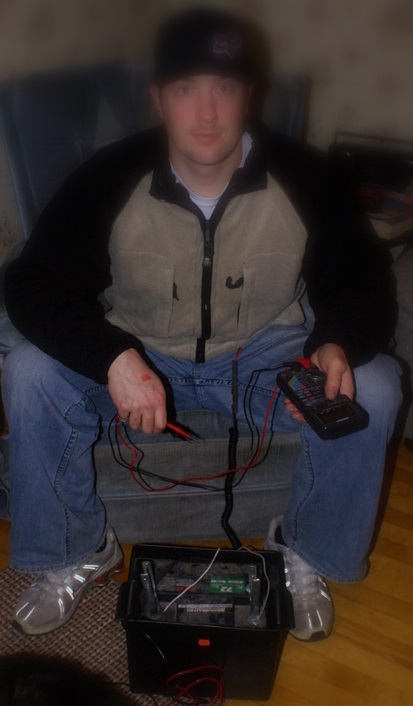
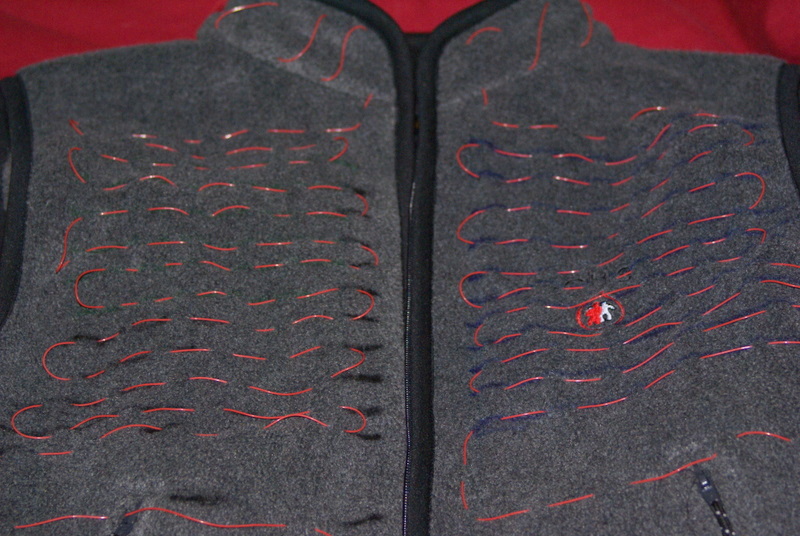
This page shall cover the details of my home made electric vest for use on my motorcycle. I got the idea from my uncle who made a very similar vest and even gave me his left over wire.
The vest is composed of the following items:
- Two used fleece vests ($8.00)
- 30 AWG multi strand Teflon Coated Copper wire($0.00, donation from John)
- flexi-cord from Princess Auto ($4.99)
To make the jacket I first measured the resistance of the wire (this is done using a multi-meter and the longest piece of wire you can find, the longer the wire the more accurate your results will be.
Because my current ride (the ZR-7S) has limited power for accessories, I wanted to limit the vest to ~ 35 Watts. This is where a little math will come in handy.
Measure the resistance of the longest length of wire you have (i.e. if you buy a spool of 100 feet measure the full length). If you are using 30 AWG multi strand wire you will likely end up with about 0.1 Ohms/foot.
Most commercial vests are in the 35 Watt range, which will give you a length of wire that you wish to use. We will also assume that we are getting 13.5 Volts from the bike while it is running.
P(ower in Watts) = V(olts) * C(urrent)
and since C = V/R we have
P = V*V/R
Example Calculation with 35 Watt vest:
35 (Watts) = 13.5 V * 13.5 V / R
35 = 182.25 / R
35 * R = 182.25
R = 182.25 / 35
R = 5.2 Ohms
Length of wire = 5.2 Ohms / 0.1 Ohms/foot = 52 Feet
Generalized Equation (assuming 13.5 Volts and 0.1 Ohms/foot)
R = feet * 0.1
feet * 0.1 = 182.25 / Wattage
Feet of Wire = 1822.5 / Wattage
After putting it all together I now have a toasty warm vest that draws 35 Watts and keeps me warm on the cold days.Teflon coated wire will be a lot safer (it is used in frying pans after all, and can withstand higher temps).
Common wire is insulated with PVC, which has a melting point of ~ 130°C where as Teflon has a melting temp of ~275°C.
The smaller the gauge wire you use (which will be the higher the AWG #) the more resistance per foot you will result in. I think that the 30AWG worked out nicely as it wasn’t that hard to put in the length of wire I needed.
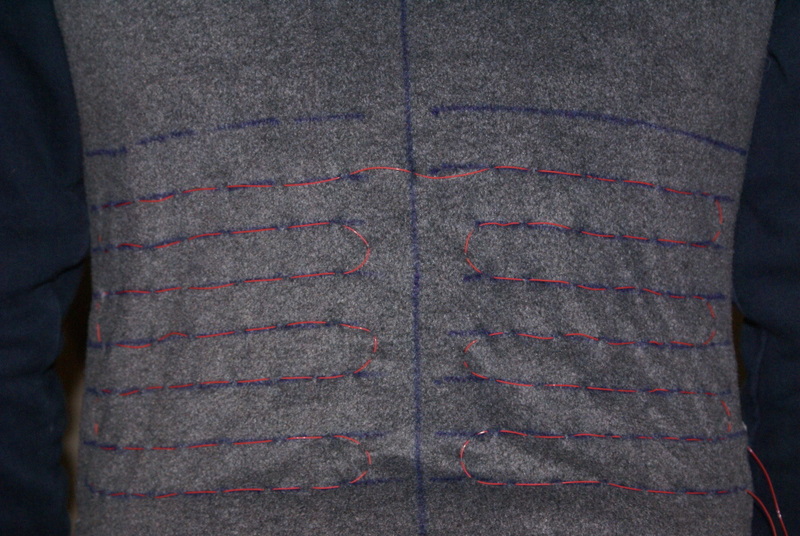
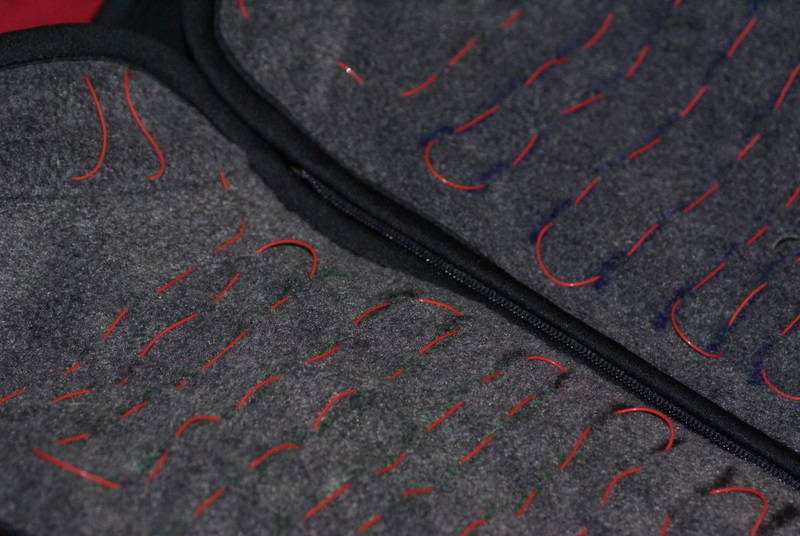
I put over 50% more length of wire on the front vs Front and also wired the collar of the neck.
V4S3L1N3
This is mad sick. I am going to stop by RS and Goodwill tonight and start-on this. Great idea for those of use who can’t afford a $200 riding jacket.
Thanks!